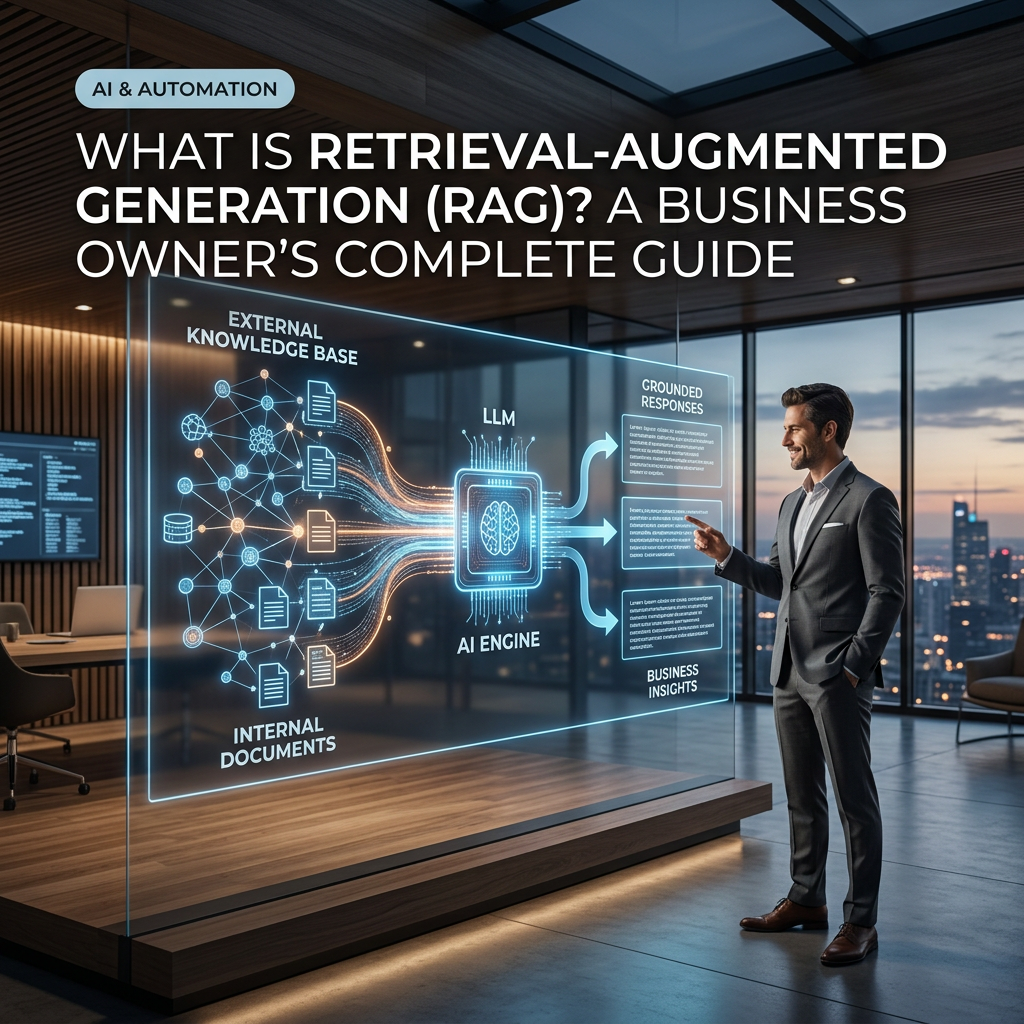
Retrieval-Augmented Generation (RAG) is revolutionizing the way small business owners utilize AI automation. If you’ve ever faced inaccuracies from standard AI assistants, you know how crucial it is to have reliable information. The hallucination problem, where AI generates incorrect data confidently, can lead to misunderstanding and mistrust, especially when it involves customer interactions or business decisions. Fortunately, RAG offers a promising solution, ensuring that AI remains accurate and trustworthy in business contexts.
Understanding RAG: Addressing AI Limitations
Hallucination Issues in AI
Most AI tools, especially Large Language Models (LLMs) like GPT-4 and Claude, can give inaccurate answers that may mislead users. For small business owners, this means that an AI might provide outdated information on policies, quote incorrect prices, or even misinform clients about services. This is not just inconvenient; it can damage business credibility and trust.
RAG combats these challenges by integrating a retrieval mechanism that ensures responses are based on factual, updated information specific to your business.
The Mechanics of Traditional LLMs
Limitations of Conventional AI
LLMs are trained on extensive datasets but come with significant drawbacks:
- Fixed Training Data Cutoff: LLMs lack awareness of new pricing, policies, or even customer interactions that happened after their last update.
- Lack of Business-Specific Knowledge: These models don’t know your specific workflows, making responses generic or irrelevant.
- Hallucination When Uncertain: Instead of admitting a lack of information, LLMs often generate plausible but incorrect responses.
These issues illustrate why relying solely on traditional AI is problematic for businesses. RAG technology addresses these gaps, enhancing AI performance significantly.
How RAG Works: A Two-Step Approach
RAG operates in two distinct phases, improving the reliability of AI interactions.
Phase 1: Information Retrieval
When a query arises, RAG kicks into action by searching a tailored knowledge base for relevant data. This involves using advanced techniques to determine semantic relevance instead of just basic keyword searches. The knowledge base, which is essential for effective AI operation, includes:
- Frequently Asked Questions (FAQs)
- Policy documents
- Product catalogs
- Client records
This ensures that the information accessed is specific to your company, providing context for more accurate responses.
Phase 2: Augmented Response Generation
After retrieving relevant data, the LLM generates responses based on this verified information rather than general training data. If a query doesn’t find any relevant entries, the system acknowledges the gap and escalates to a human agent instead of providing incorrect information.

Creating an Effective Business Knowledge Base
The success of a RAG system hinges on the quality and comprehensiveness of its knowledge base.
Essential Components of a Knowledge Base
For most small to mid-sized businesses, this includes two categories:
Static Documents
- FAQ documents with the most common customer inquiries
- Policy and procedure manuals
- Current product and service catalogs
- Employee training materials
Dynamic Data Sources
- Live CRM data
- Real-time scheduling information
- Inventory data
- EHR systems for healthcare providers
- Financial records
These dynamic connections empower RAG-enabled agents to retrieve accurate information about specific circumstances, making interactions personalized and precise.
Real-World Applications of RAG
The impact of RAG in practical scenarios is significant. Here’s how it changes the game:
Customer Support Without RAG
Customer: "What’s your cancellation policy if I cancel within 24 hours?"
Generic AI Response: "Most businesses have a 24-hour cancellation policy. Please check with the business for specifics."
A vague response that leaves the customer frustrated.
Customer Support With RAG
Customer: "What’s your cancellation policy if I cancel within 24 hours?"
RAG-Powered Response: "If you cancel within 24 hours, a cancellation fee of $35 applies as per our policy updated in January 2025. If you choose to reschedule instead, the fee is waived. Would you like to proceed with rescheduling?"
This response is not only precise and useful but demonstrates a clear understanding of your business, enhancing customer satisfaction.

Healthcare Query With RAG
Patient: "When is my next appointment, and what insurance do you have on file?"
RAG-Powered Response: "Your next appointment is on Thursday, March 14th, at 2:30 PM with Dr. Williams. We have Blue Cross Blue Shield PPO on file. Would you like a reminder?"
This specific response reflects real-time context and ensures the patient feels valued and informed.
Ensuring Compliance with RAG: Crucial for Regulated Industries
In sectors like healthcare and finance, RAG isn’t just beneficial—it’s essential. Inaccuracies in these fields can lead to severe consequences. RAG guarantees that AI agents provide only verified information and, when uncertain, clarifies that it cannot respond accurately.
Additionally, RAG enables the traceability of responses, an essential feature for compliance in regulated environments, ensuring that all interactions can be audited and verified.
How Coregentic AI Implements RAG for Your Business
At Coregentic AI, we specialize in RAG-powered implementations tailored to your small business needs. Our process involves:
- Knowledge Base Design: We map your data architecture and gather relevant sources.
- Document Ingestion: We process your current documentation for semantic search optimization.
- Dynamic Data Integration: We connect live systems for real-time data retrieval.
- Retrieval Optimization: We fine-tune search algorithms for better accuracy.
- Ongoing Maintenance: We ensure your knowledge base remains up to date.
Ready to see how RAG can transform your workflows? Book a free consultation today to learn how our solutions can provide accurate and trustworthy automation for your business.
Frequently Asked Questions About RAG
How often should the knowledge base be updated?
Static documents like policies should be reviewed quarterly, while dynamic data sources update in real-time. Once set up, maintaining a knowledge base typically requires minimal effort.
Can RAG systems handle confidential data securely?
Absolutely. We employ configurable access controls that restrict data access based on interaction context, ensuring sensitive information remains secure.
How does RAG manage questions outside its knowledge base?
When no relevant information is found, RAG systems acknowledge the lack of data and escalate to a human, providing a trustworthy alternative to erroneous responses.
Is RAG the same as bots searching the internet?
No, RAG focuses on a controlled, curated knowledge base. Internet-connected AIs might access unreliable information, but RAG ensures the accuracy and appropriateness of responses for your business needs.
For tailored AI solutions that optimize your business processes, visit our consultation page and start your journey toward reliable AI automation.